Iowa homeowners are getting squeezed as insurers hike premiums and deny claims, even as they post record profits nationwide. Iowa home insurance rates rose 96% between 2020 and 2025, the second-largest increase in the country behind only Colorado, and climbed another 28% in 2025 alone, the third-highest one-year increase of any state that year. Home insurance costs now consume over 10% of Iowans’ household budgets.
Insurance companies are passing the costs and risks associated with climate change onto policyholders, while continuing to underwrite and invest in the same polluters responsible for the crisis. Iowa has been hit by repeated billion-dollar disasters, including the August 2020 derecho that caused more than $11 billion in damage, the costliest thunderstorm in U.S. history, and catastrophic June 2024 flooding in northwest Iowa that triggered a major disaster declaration and forced FEMA to eventually spend more than $22 million buying out 123 flood-damaged homes in Rock Valley alone.
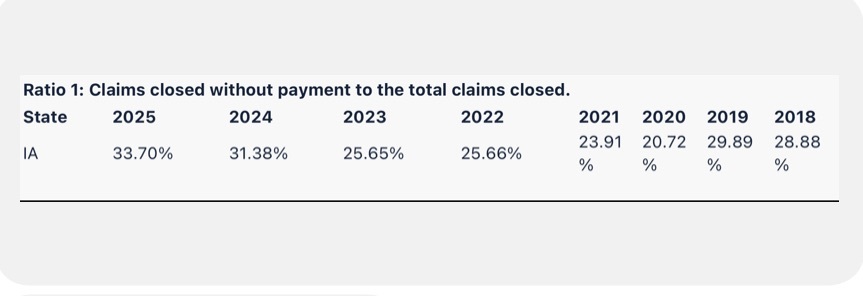
Despite the mounting losses, Farm Bureau Property & Casualty Insurance Co., an insurer domiciled in Iowa, denied 70.5% of homeowner claims nationally with zero payment, among the worst denial rates of any large insurer in the country. Overall, claims closed with no payment climbed to 33.70% last year in Iowa. Nationally, home insurance corporations make millions every day a claim is delayed, while homeowners might not even have a roof over their head.
Meanwhile, the Trump administration and congressional Republicans are cutting the very federal tools meant to help Iowans prepare for and recover from the storms driving these costs higher. New polling found 75% of voters in Iowa, Nebraska, and Kansas are concerned about the rising cost of home insurance over the next three years, making it one of the top affordability issues heading into the midterm elections.
Iowans Are Paying More, Getting Less While Home Insurers Profit
Fact: Iowa home insurance rates rose 96% between 2020 and 2025, nearly four times faster than the state’s income growth and the second-worst increase nationally, behind only Colorado.
Fact: Rates climbed another 28% in 2025 alone, one of the six largest single-year jumps in the nation, part of an increase of 54% in just two years.
Fact: Home insurance costs consume 10.6% of Iowans’ monthly household budget.
Fact: Foreclosure rates have climbed for two consecutive years, and Iowa currently has the 14th highest foreclosure rate in the nation.
Fact: The share of Iowa homeowner claims closed with no payment climbed to 33.70% in 2025, up from 25.66% in 2022, an 8-point jump in just three years.
Fact: Property and casualty insurers made an unprecedented $405 billion in profit over the last three years nationally, even as they raised prices for Iowa families and pushed for laws to avoid paying claims.
Fact: Farm Bureau Property & Casualty Insurance Co., domiciled in Iowa, denied 70.5% of homeowner claims nationwide with zero payment, among the highest denial rates of any large insurer in the country.
Fact: At least four insurers have stopped writing new homeowners policies in Iowa, even as the industry as a whole continues to post record nationwide profits.
Fact: The August 2020 derecho caused more than $11 billion in damage across Iowa, the costliest thunderstorm in U.S. history, and less severe derechos struck the state again in December 2021, May 2022, June 2023, and July 2024.
Fact: In May 2024, an EF-4 tornado devastated Greenfield, Iowa, killing five people and damaging or destroying 153 homes, part of a record 125 tornado touchdowns statewide that year.
Fact: In June 2024, catastrophic flooding in northwest Iowa forced a major disaster declaration across more than 20 counties, and FEMA later obligated over $22 million to buy out 123 flood-damaged homes in Rock Valley alone.
Fact: 75% of voters in Iowa, Nebraska, and Kansas said in new polling that they are concerned about the rising cost of home insurance over the next three years.
Fact: Every congressional Republican from Iowa voted for Trump’s cuts to NOAA and weather forecasting, driving up insurance costs.
Congressional Republicans Are Making Iowa’s Crisis Worse
Iowa’s 4th congressional district Rep. Randy Feenstra (R-Hull), whose northwest Iowa district includes Rock Valley and Sioux County, responded personally to the catastrophic June 2024 flooding that devastated his own constituents. Less than a year later, as a member of the House Ways and Means Committee, Feenstra voted to pass President Trump’s “One, Big, Beautiful Bill,” which repealed funding for NOAA’s atmospheric research and weather forecasting programs, the very tools Iowans depend on to track severe storms and tornadoes. Feenstra also co-sponsored the Tackling Predatory Litigation Funding Act, which would impose a steep new tax on third-party litigation financing, a tool that helps homeowners afford legal challenges when insurers deny or underpay claims.
Rep. Ashley Hinson (R-Marion), representing Iowa’s 2nd congressional district, including Cedar Rapids and one of the communities hit hardest by the 2020 derecho, has been trying to run from President Trump and her vote for the same devastating cuts in the “One, Big, Beautiful Bill.” Finance, insurance, and real estate interests have poured more than $3.5 million into Hinson’s campaigns since 2020, according to OpenSecrets.
Iowa’s 1st district Rep. Miller-Meeks (R-Ottumwa), including communities of Davenport, Bettendorf, Burlington, and Iowa City, has almost completely avoided the issue despite the devastating impacts on homeowners, farmers, small business owners, and renters. Miller-Meeks does not reside in her district, yet she voted for the same cuts to weather forecasting and NOAA and has failed to stand up to Trump’s tariff taxes, driving up home insurance costs. She joined the House DOGE caucus, supporting unelected Elon Musk’s reckless and wasteful efforts. Miller-Meeks has cashed in over $1.16 million in campaign contributions from the insurance, financial, and real estate sector for her 2026 re-election campaign so far.
Rep. Zach Nunn (R-Bondurant), representing the state’s 3rd district, including the community of Greenfield, also voted for the cuts in Trump’s “One, Big, Beautiful Bill” to slash NOAA and weather forecasting. Nunn has been a vocal supporter of Trump’s tariffs and has voted against measures to repeal them. He’s also supported Trump’s efforts to politicize disaster relief and recovery funds. Nunn has taken in a whopping $1.5 million in campaign cash from the insurance, financial, and real estate sector, with over $46,000 coming directly from the home and auto insurance sector. Nunn has also taken in nearly $200,000 from natural resources, utilities, and fossil fuels for his campaign this cycle.
Solutions Exist to Lower Costs and Protect Iowa Homeowners
Iowa’s Republican representatives in Congress need to stop making this crisis worse for their constituents. They should:
- Put their constituents first and rein in egregious home insurance profits;
- Restore full funding to NOAA’s weather forecasting and research programs;
- Release the FEMA disaster reimbursements and mitigation grants already owed to states;
- Reinstate programs, like BRIC, that help communities prepare before storms hit;
- Fully fund and fix the National Flood Insurance Program;
- Prevent insurers from using credit scores in premium pricing;
- Hold polluters accountable for climate-driven risks and damage;
- Require insurers to provide full disclosure, including profit margins and investments, alongside rate hike requests;
- Require transparency and regulate for new surplus lines of insurance;
- Require more national data transparency to allow state lawmakers and regulators to address market inefficiencies and gaps across states; and
- Finally, at the very least, Iowa residents should expect their federal lawmakers to hold hearings on insurers’ pattern of delay, deny, and defend practices harming policyholders.
A coalition of congressional Democrats has launched an investigation into insurers’ use of credit scores, and Oklahoma is taking insurers to court over the industry’s fraudulent practices. Numerous solutions exist to help lower risks and costs for Iowa families if politicians and regulators choose to act.
For questions or to connect with an insurance expert, ratings analyst, policymaker, or impacted homeowner, please email jayson@focalpointstrategygroup.com.
###